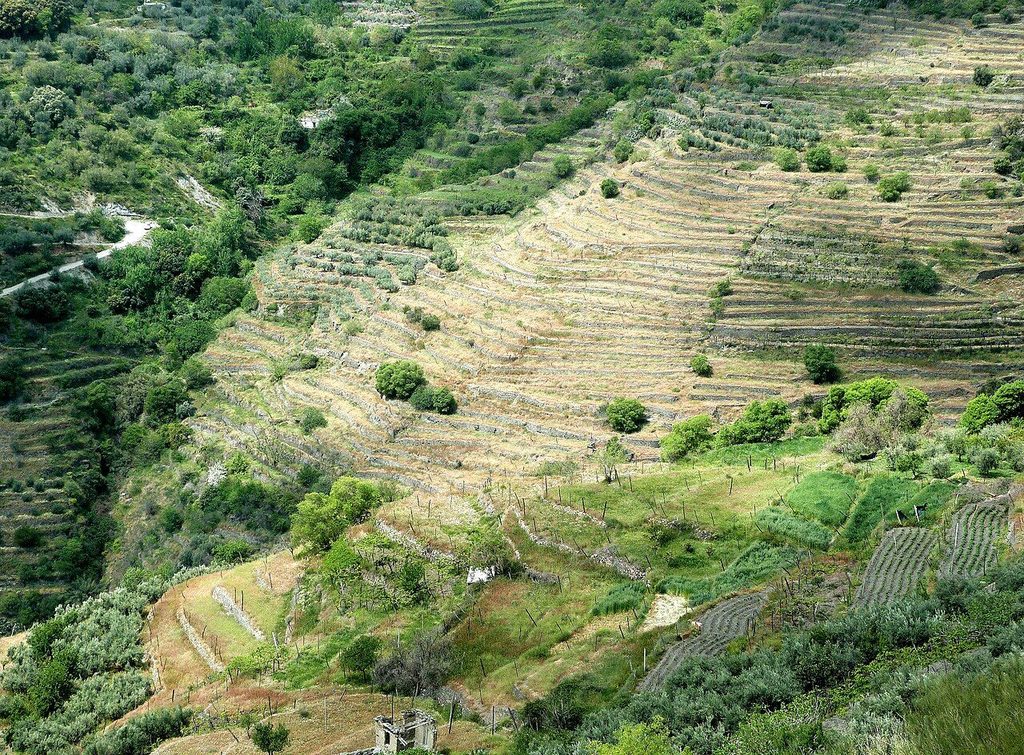
The Alpujarra's green slopes are man-made: terraces held up by stone walls and watered by channels that carry Sierra Nevada snowmelt across the mountainside.
- Area: Alpujarra-wide
- From Granada: One to two hours by car
- Best months: April, May, June, October
- Bring: Walking shoes, water, a map
Field note: Acequia paths are narrow and the channels are working water rights. Keep to the path, never block or divert the flow, and do not drink from open channels.
Look at any slope in the Alpujarra from across a valley and you will see lines: terraces cut into the hillside, held up by dry-stone walls, stepping down from the villages to the rivers. Look closer and you will find water moving along the contour in narrow channels, the acequias. Together they turned steep, dry mountainsides into land that could grow grain, fruit, vegetables and mulberry trees. Much of the system was laid out in the Middle Ages, under Muslim rule, and it still works.
How the acequias work
The Sierra Nevada holds snow through the winter and spring. As it melts, it feeds the streams that run down to the Alpujarra. The acequias tap these streams high up and lead the water off sideways along the slopes, at a gentle fall, to the villages and their fields. Sluices and small stone gates let farmers send water onto each terrace in turn.
Some channels do something less obvious. The acequias de careo, high on the mountain, take snowmelt in spring and spread it onto porous ground, where it soaks in. Over the following weeks and months it seeps down through the slope and reappears lower down as springs, keeping fountains and fields watered into the dry summer. It is a way of storing water in the mountain itself.
Water is shared by turn. Irrigation communities in each village set the days and hours each plot may draw water, and the rules are old and strictly kept. Disputes over water have a long history in the region.
The terraces
The terraces, known locally as bancales or paratas, are built from the stone cleared out of the soil. Each wall holds back a strip of flat ground, wide enough to plough or dig. On the steepest slopes a terrace may be only a few metres deep. The work of building and keeping them up, across whole valleys, is hard to overstate.
Many terraces are now abandoned, especially the high ones far from roads, and you will see their walls slumping under broom and bramble. Others are still farmed, with vegetables, fruit trees and olives lower down, and chestnuts higher up. You can see both kinds clearly from the villages of the Poqueira gorge and the valley below Trévelez.
The Moriscos and the revolt
When the Nasrid kingdom of Granada fell to the Catholic Monarchs in 1492, its surrender terms promised the Muslim population their faith, laws and customs. Within a decade those promises were broken. Forced conversion followed around 1500, and the converted Muslims, now called Moriscos, became nominal Christians who kept much of their language, dress and way of life. The Alpujarra, remote and densely settled, was one of their heartlands. Its silk, from mulberry trees grown on the terraces, was an important trade.
See also: Walking the Alpujarra
In 1567 a royal decree banned the Arabic language, Morisco dress and many customs. At Christmas in 1568 the Moriscos of the Alpujarra rose in revolt. They chose as their leader a man of noble descent, Fernando de Válor, who took the name Aben Humeya. The war that followed was brutal on both sides and lasted until 1571. It was ended by royal armies under Don Juan of Austria, after Aben Humeya had been killed by his own followers and his successor, Aben Aboo, had also died.
After the revolt, the Moriscos of the kingdom of Granada were deported and scattered across Castile. The Alpujarra was resettled with families from the north of Spain and elsewhere. Many villages were left half-empty, and the newcomers did not always know how to run the irrigation they inherited. A final expulsion of all Moriscos from Spain followed between 1609 and 1614.
What remains
The villages kept the shape their first builders gave them: flat roofs, stepped plans, tinaos, fountains fed from the acequias. Place names are full of Arabic roots. The castle ruins at Lanjarón, fought over in the revolt, are described in Lanjarón and Órgiva. And the water still runs in the channels that Morisco farmers dug and maintained.
Several walking paths follow acequias along the contour, which makes for level, shaded walking with water beside you. Keep to the path, do not step into the channel or move stones, and remember that the water is someone's harvest.